The Data
North Carolina is the 9th largest state in the US, it’s also one of the fastest-growing states. We took a look at the data to see how we stack up against states that have successful MLB franchises and found that not only would it be viable here, but that it would thrive. Take a look at the numbers. They may surprise you.

North Carolina is the largest state in the U.S. without an MLB team
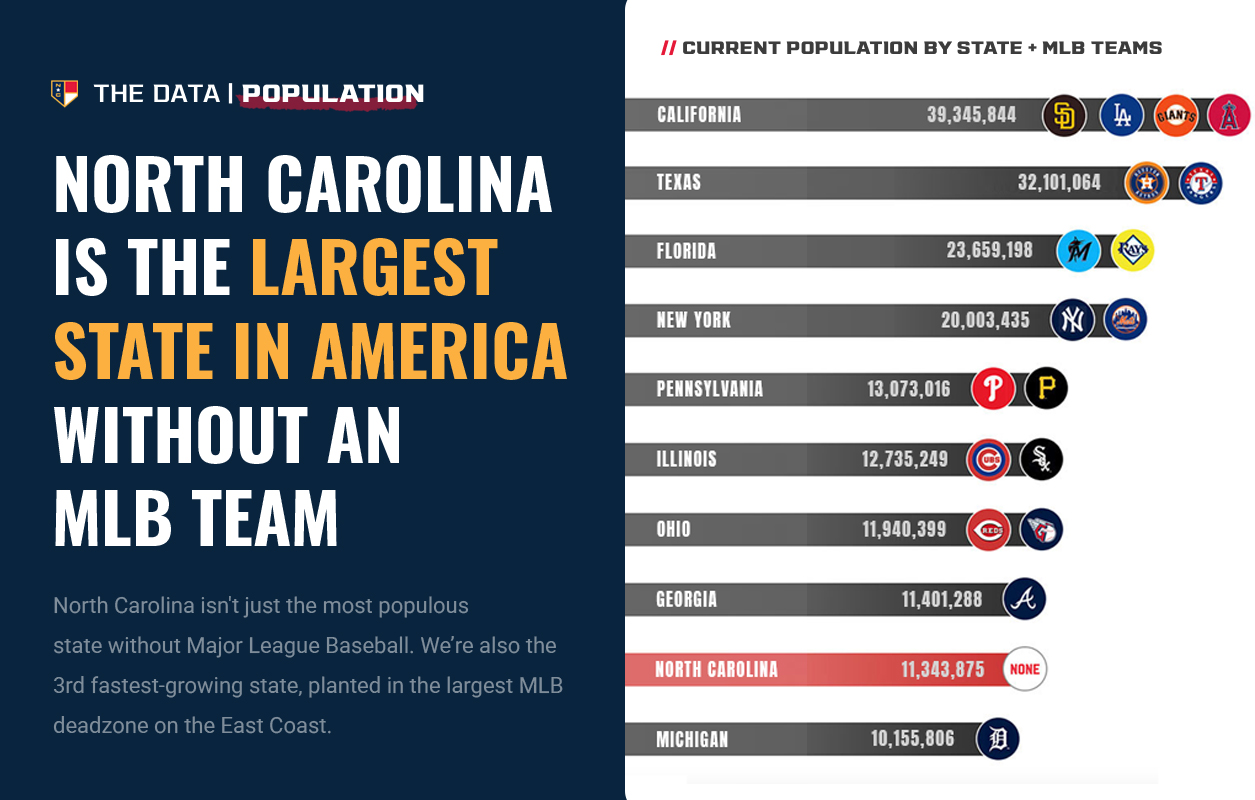
Did you know that North Carolina is the 9th largest state in the US? Did you also know that we are the largest state in America without Major League Baseball? We took a look at the 10 largest states (based on population) and looked at which ones had one or more MLB teams.
Turns out, we are the only Top-10 state without a Major League Baseball team. In fact, 7 of the Top-8 have multiple teams.
California, the largest state in the US, has the 4 (or 5) teams. The Padres, Dodgers, Giants and Angels are all located in Golden State, and up until the end of this season, they also had the Oakland A’s (The A’s will play the next couple seasons in Sacramento, CA before moving to Las Vegas, NV).
The next six most populous states all have 2 MLB teams, with Georgia (7th) only having the Braves.
Then there’s North Carolina, the 9th largest state in the country, sitting in the largest MLB dead zone on the East Coast, without a team.
This is an important metric because baseball, unlike all of the other major sports, pulls fans from further outside their direct region thanks to its 3-game series set-up. Fans come from all corners of the state to catch a couple of weekend games before driving just a couple of hours back home. This is why Raleigh is the most logical landing spot for MLB in North Carolina. It’s just 2 hours from the fast-growing coastline and just 3 hours from NC’s other most populous hub, Charlotte. Meanwhile, the Triangle is the second fastest-growing region in the country, and Wake County (where Raleigh is located) is now larger than Mecklenburg County (where Charlotte is located.)
This gives North Carolina a huge population to pull from. No matter where you are in the state, you currently can’t get to a Major League stadium in less than a 4-hour drive.
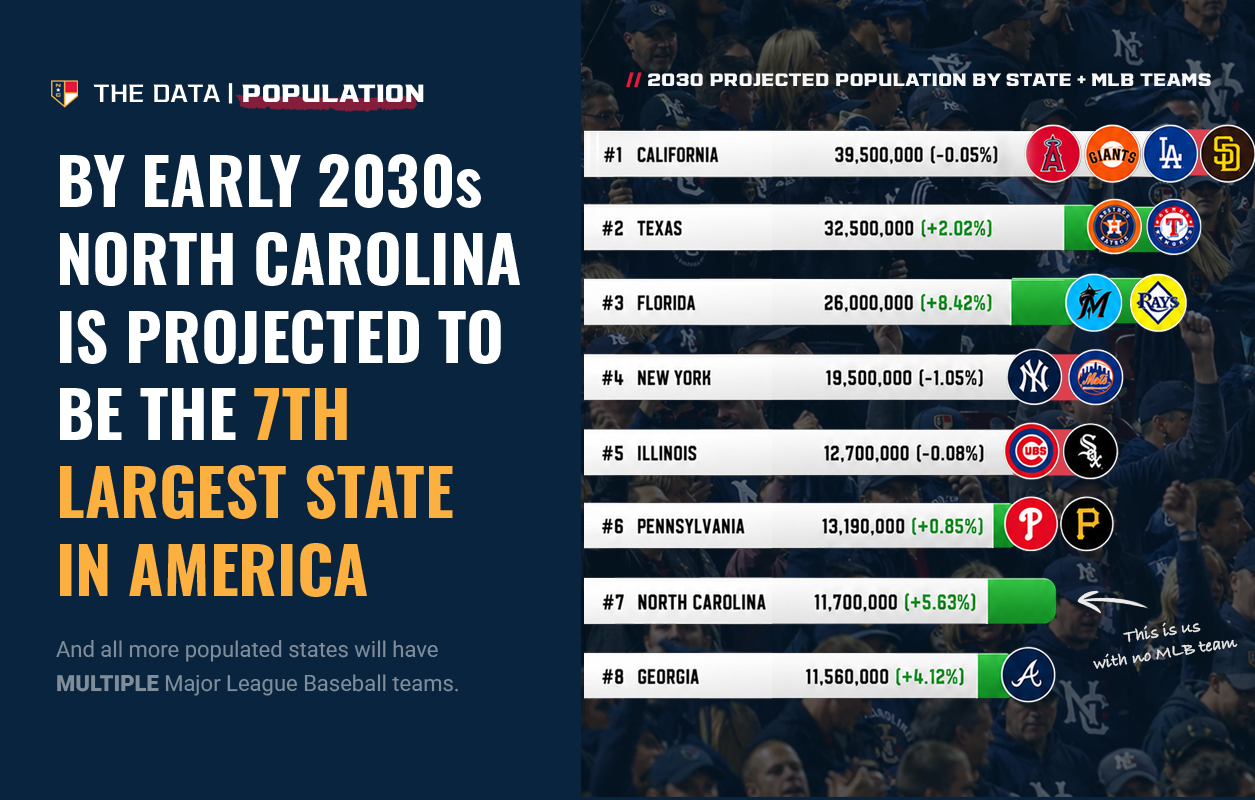
Oh, and did we mention we’re the 3rd fastest growing state in America? That means, by early 2030, the rankings will look like this…
North Carolina has 3 Top-50 Media Markets
Media Market is important for Major League Baseball.
The revenue from local media makes up more than 23% of total team revenue. That’s more than any of the other 4 major sports, and a reason why having multiple large media markets within the state is a huge plus when the league looks at expanding to the southeast.
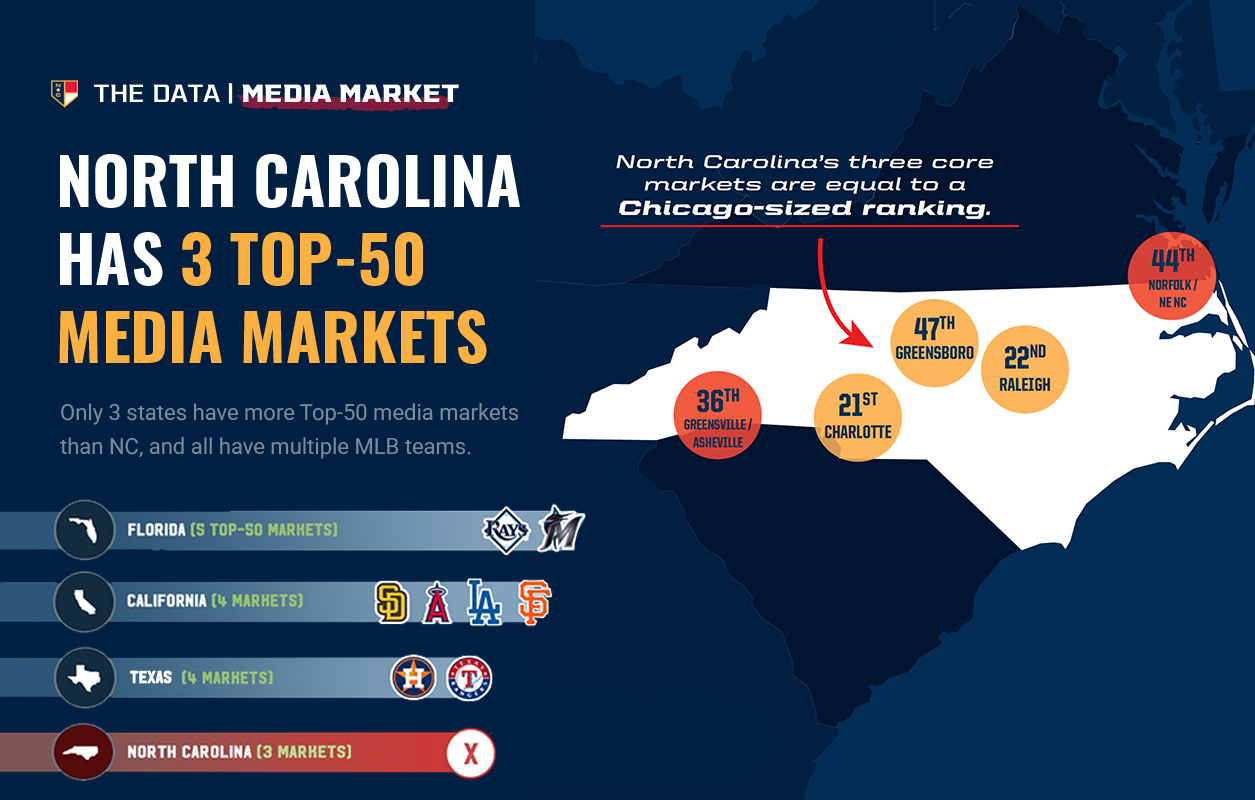
There currently are 6 states that boast 3 or more Top-50 media markets, with NC being one of them. However, we are the only one of those who do not have a current Major League Baseball team.
Florida has 5 Top-50 markets, and two MLB teams. California has 4 Top-50 markets and 4 (or 5, if you count the A’s) teams. Pennsylvania, Texas and Ohio have 3 Top-5o markets and each have 2 teams. Meanwhile, NC has 3 Top-50 markets and no MLB team.
This is a huge plus, as all of those other states have multiple teams that need to split up the revenue generated by MLB inside their state. North Carolina wouldn’t have that problem. With a single team, the entire state would be tuned in and rooting for the NC-based team, created an unprecedented population pool and then an unprecedented ability to create revenue from media.
North Carolina’s 3 Top-50 markets are Raleigh-Durham (#22), Charlotte (#21) and Greensboro (#47 Greensboro). However, the Greenville-Spartanburg-Asheville-Anderson (#37) media market also overlaps into North Carolina as does the Norfolk-Portsmouth-Newport News market (#44).
And when you look at the other current expansion contenders, they don’t come anywhere close.
Tennessee (Nashville) has only one Top-50 market, as does Oregon (Portland) and Utah (Salt Lake City).
North Carolina sits in MLB's largest East Coast dead zone
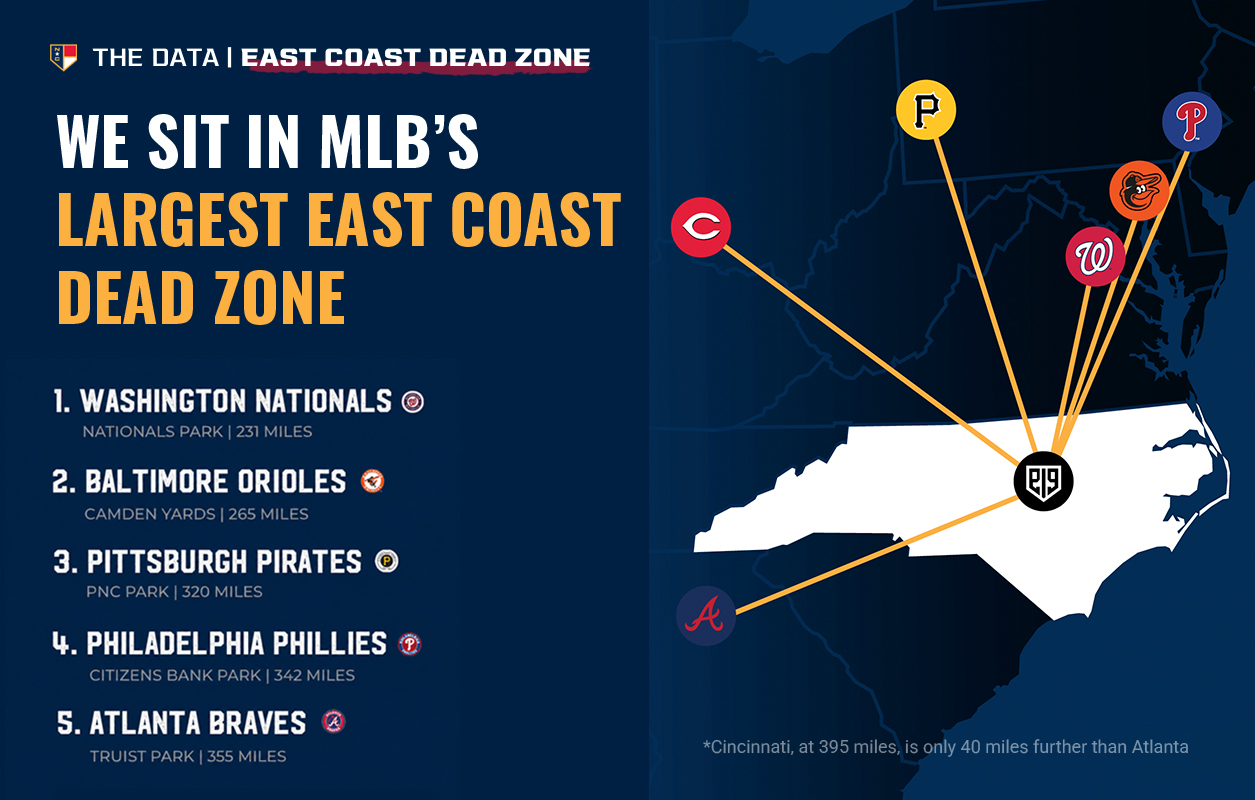
North Carolina sits right in the heart of MLB’s biggest East Coast dead zone. We don’t have our own team, and the Raleigh area is farther from big-league baseball than just about anywhere else on the East Coast. A lot of people assume the Atlanta Braves are our closest team, but they’re actually the fifth-closest. The list from Raleigh shakes out like this: Washington Nationals (231 miles), Baltimore Orioles (265 miles), Pittsburgh Pirates (320 miles), Philadelphia Phillies (342 miles), and then finally the Atlanta Braves (355 miles). Even Cincinnati is only about 40 miles farther than Atlanta.
North Carolina is one of the fastest-growing states in the country, but MLB still isn’t cashing in. Raleigh sits outside the Braves’ territorial rights, which opens the door for expansion. And compared to other potential expansion markets, Raleigh has the least overlap with existing MLB team territories. That means less market conflict and a cleaner shot at bringing a new team to one of the biggest underserved areas in the league.

This project started with one question. “Could the Triangle support a Raleigh-anchored MLB team?” After reviewing the statistics, it became evident that not only was it possible, but it made sense. Here are the eye-opening numbers.
The Triangle's population is in line with established MLB markets and growing faster
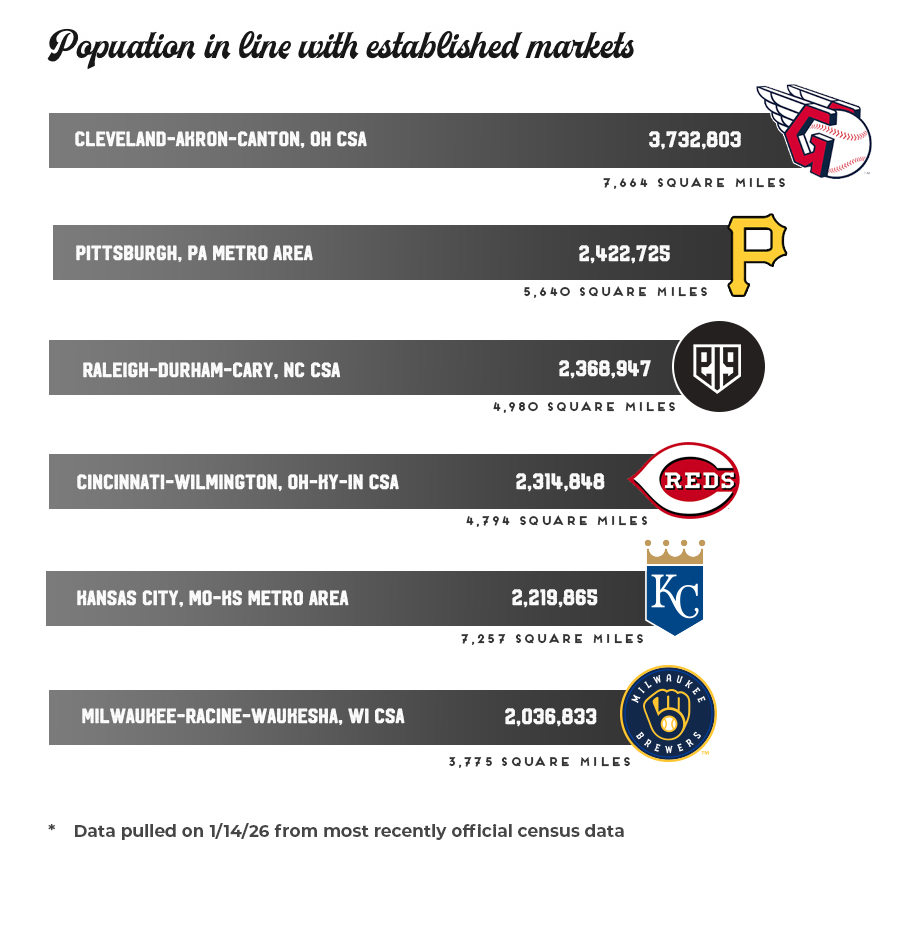
Did you know that the Triangle’s population is in line with MLB markets such as Milwaukee, Kansas City, Cincinnati, Cleveland and Pittsburgh (all of which have MLB teams)?
If you didn’t, you’re not alone.
Measuring the Triangle’s population in comparison with other metro areas that support MLB teams sounds like it’d be an easy task. However, thanks arbitrary definitions that don’t take into consideration the unique setup of the Triangle, it’s actually quite complicated.
Prior to 2000, the area’s growth and population were being measured using what was called the Raleigh-Durham MSA. The MSA (Metropolitan Statistical Area) is a common data point that cities use to measure population and density within a region’s commuter belt.
Because of the Triangle’s unique layout where 3 key population centers fall within one commuter belt (and are less than 25 miles apart), a combined MSA made sense.
It gave a true snapshot of the population radius of the area and gave a good idea of the area’s ability to support things that would draw from the surrounding area (like professional sports).
In 2000, the census split Raleigh and Durham’s MSA thanks to adjustments made to the definition of a ‘Metro Statistical Area’. They took into consideration the percentage of commuters who commute into the city, however, we have a central area called Research Triangle Park in the middle of both Durham and Raleigh where most of our workforce commutes. The county line goes right through the middle of RTP, and thus, you can see how arbitrary that ‘commuter percentage’ ends up being.
This change created a situation where you now had the census reporting the Triangle area as two smaller cities. This dropped the region off of many lists and rankings that had them approaching major metro status. To this day, the census discrepancy continues to exist.
So how do you get a true idea of how the Triangle would rank against other regions in total population?
Well, the official Raleigh MSA isn’t going to be accurate anymore for us. However, we can get a much better apples-to-apples comparison by recombining the former Raleigh-Durham MSA. We do this by simply taking the Raleigh MSA and adding it to the Durham MSA.
According to the latest numbers, that Raleigh-Durham MSA has a total population of 2,368,947 (covering nearly 5,000 square miles).
When we put our market up against existing markets, what we found was what we expected. The Triangle’s density is on par with a number of established MLB markets and growing faster than all of them.
The Triangle’s population comes in ahead of Cincinnati, Kansas City, and Milwaukee.
If that isn’t enough, only one other metro area (Austin, TX) grew faster (net population growth %) than the Raleigh metro area from 2016 to 2021.
And this is where it all gets really interesting.
Growth Rates show the Triangle market eclipsing all Small-Market Baseball in 15 years.
See, MLB isn’t investing for today. They will be investing in a region for the foreseeable future, meaning growth forecasts really matter, and this is where the Triangle shines.
By 2037, adding in forecasted growth rates, the Triangle finds itself well above ALL of small-market baseball. Above, Kansas City, Cincinnati, Pittsburgh, Cleveland, and Milwaukee. In fact, we’d be right on the cusp of mid-market cities like St. Louis.
The point is, a Raleigh-anchored team in this region is already feasible based on the current population/density numbers and we just so happen to be growing faster than any other MLB market.
**All statistics based on Census.gov’s latest ACS (American Community Survey) numbers and population/growth data from the NC Dept of Commerce.
Raleigh has a larger population within 60-miles than all expansion contenders and some current MLB cities
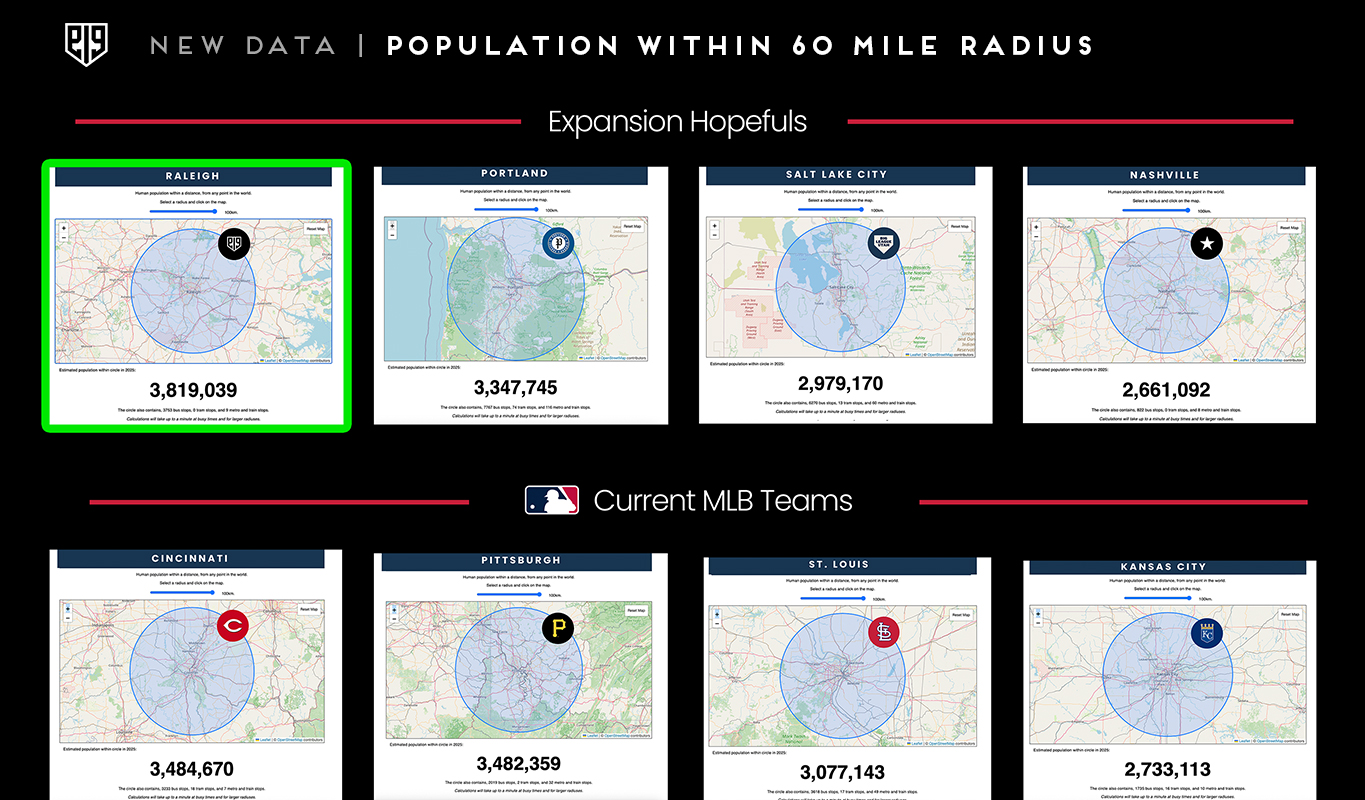
We used a census radius tool that scopes a custom area and pulls the census data directly from that desired area. For each region that has a current MLB team, we set that spot to their existing stadium. For the expansion-contending cities, we looked at the most recent proposed location for a stadium. We set the tool to measure a 60-mile radius (approximately a 1-hour drive). Here is what we found…
Raleigh’s population density within that 60-mile radius was not only larger than every single MLB expansion contender, but it was also larger than some areas that boast extremely successful MLB teams such as Cincinnati, St. Louis, and Pittsburgh. Also, not pictured was Milwaukee (3,580,570), which ranks #1 in per capita attendance in MLB.
So if the question is “Does Raleigh have enough population density to fill a Major League Baseball stadium 81 nights per year?”, the answer is: If Cincinnati, Pittsburgh, St. Louis, Kansas City, and Milwaukee have the population volume to fill their stadiums, then so does Raleigh.
And with Nashville, Salt Lake City, and Portland being the current competing markets for MLB expansion, why wouldn’t you choose Raleigh? We are not only growing faster than every single MLB market, but also boast more people within driving distance of a potential stadium than any other current option on the table.
The Raleigh/Durham TV market is the #1 largest in the nation without a locally or regionally broadcasted MLB team, ranking 22nd overall
One of the primary reasons that MLB commissioner Rob Manfred will be looking at North Carolina when it’s time to expand is the fact that the closest teams are The Washington Nationals to the North, and Atlanta Braves to South.
Actually, it isn’t just distance that is keeping Triangle residents from watching baseball. It’s also the fact that they don’t have a local MLB broadcast, (both the Orioles and Nationals are blacked out here due to territory disagreements with cable providers and the Braves coverage doesn’t extend this far east).
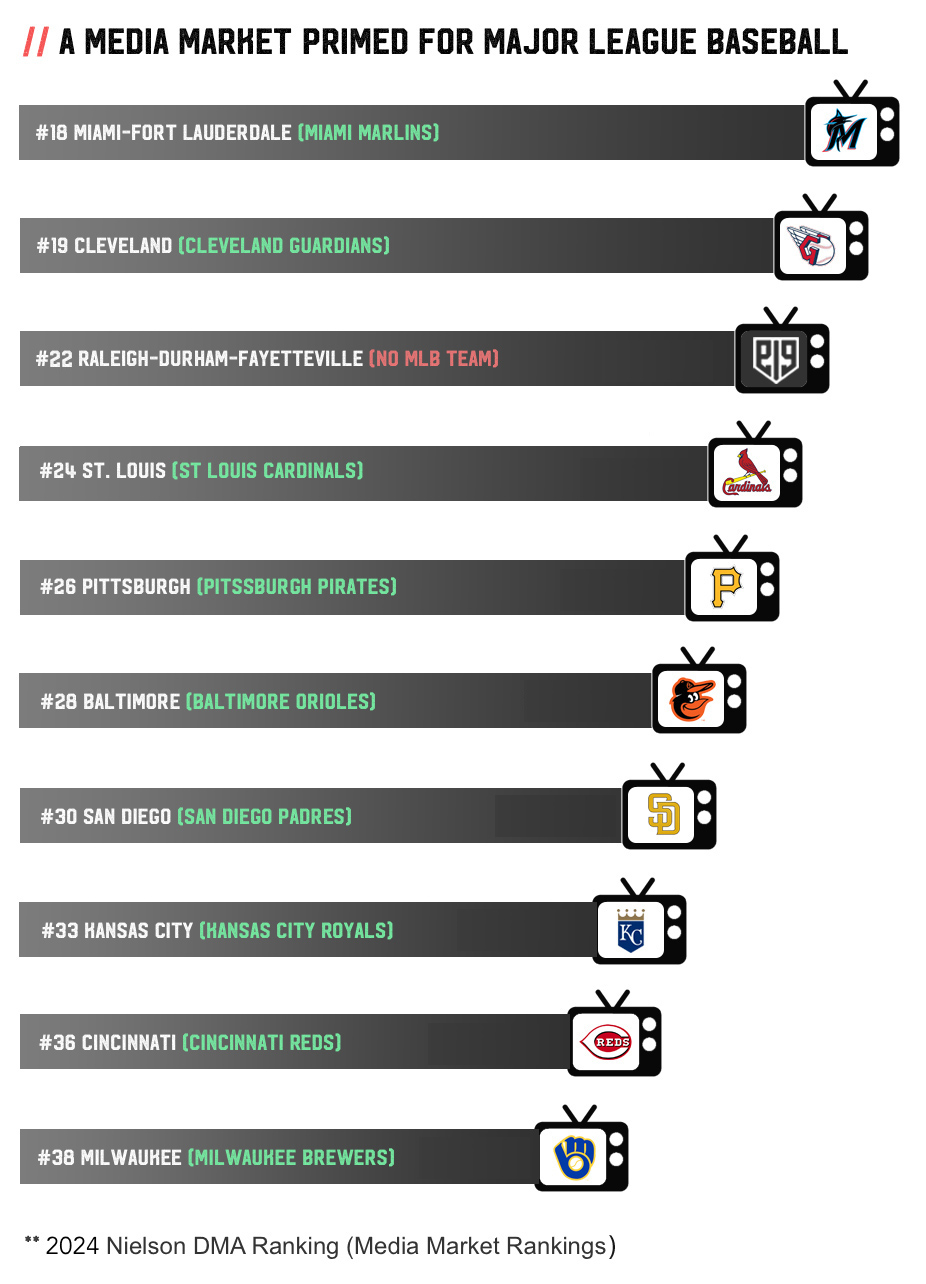
Statistically, Raleigh/Durham has the largest TV market in the USA without a locally or regionally broadcast MLB team. While there are three cities ahead in these rankings that do not have MLB teams in their city, they are all close enough to teams that they are included in the regional broadcasts..
If you’re wondering if Raleigh’s TV market could support an MLB team based on size, it can. As it stands currently, Raleigh/Durham’s TV market is already larger than the markets of St. Louis, Pittsburgh, Baltimore, San Diego, Kansas City, Milwaukee, and Cincinnati, all of which are markets that support MLB teams.
Our region also has stronger media markets than many other expansion hopefuls such as Portland (#23), Nashville (#26), Salt Lake City (#27), San Antonio (#31) and Las Vegas (#40). Meanwhile, the Triangle is just .027% away from passing Charlotte (#21).
An MLB team would have very little regular season overlap with other major sports teams in the Triangle

With a Top-25 TV market, Raleigh-Durham is in a unique spot when it comes to sports. They have some of the best college basketball in the country, and North Carolinians love their football, but in Raleigh, the only competing pro sports team would be the Carolina Hurricanes.
ACC college basketball goes from November to March. ACC college football regular season goes from the last day of August to December, with meaningful games not usually getting started until mid-September. Then there is hockey. The NHL regular season goes from October to early April.
Baseball season starts in early April and goes through October. This would mean baseball regular season would really only overlap with College football in September and overlap with the hockey regular season for a few days in April.
**There would be about another total month overlap if teams were to make post-season
It’s rare that a metro with a Top-25 TV market and a population base this large would have a 6-month major sports gap from April to September. This would bode well for TV ratings and ticket sales, keeping fan’s attention and financials-focused on the baseball team for a majority of the summer.
MLB in Raleigh would generate more tax revenue for the city than any other pro-sport (and it's not even close)
Population numbers, TV market size, and area income stats are all important when you’re talking about viability for professional sports in a city. But that is just one side of the coin.
The other thing that needs to be weighed is whether or not a new stadium and a professional franchise are financial ‘net-positives’ for the city.
Baseball nay-sayers like to mention the fact that attendance for the sport was down a few percentages the last season. They like to talk about how football is the new ‘America’s pastime’ or how soccer is the fastest growing sports in the country.
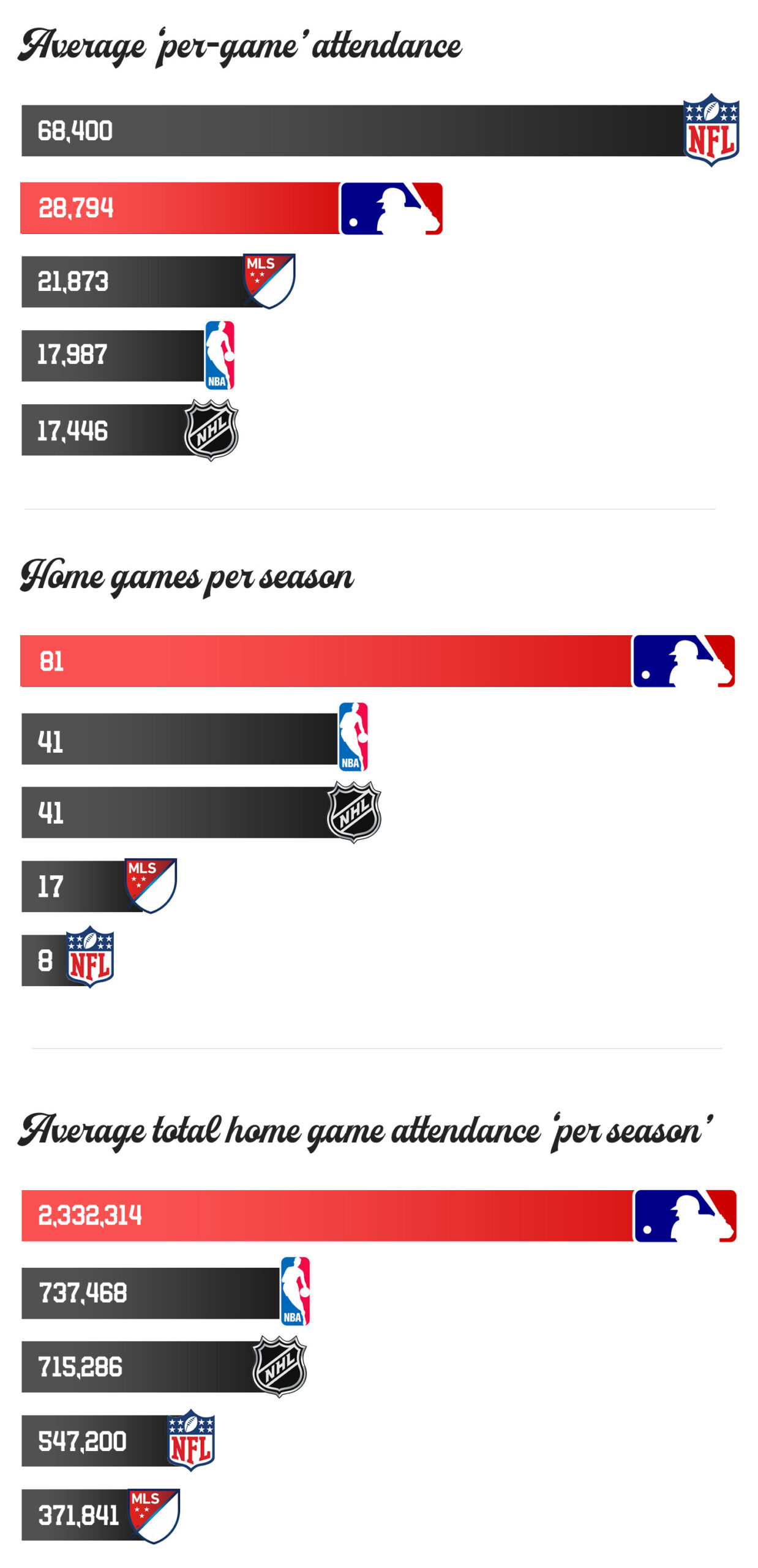
Sure, Football is doing fine and soccer is growing, but those comments hold a lot less water when you put everything in context. In fact, no major sport in America brings more fans per season to the stadium than Major League Baseball (and it’s not even close).
You’ll see that NFL is far and away averaging the most fans per game, but look who comes in 2nd on that list. It’s Major League Baseball at over 28k per game. Then there’s almost a 7,000 fan per game buffer before you get to MLS, who is respectably filling up the stands as well.
The per-game attendance numbers are popular and easy to find in the media. MLS uses this number a lot to show that their sport is gaining popularity. NFL uses these numbers to try to prove utter dominance in the American sports landscape. However, this stat doesn’t tell you the full story.
To understand just how popular a sport is and how much of an impact a franchise would have on a city, you have to pair it with the number of home games that team would play per-season.
What you find is that MLB far and away has the most home games with 81. NBA and NHL are next with 41 a piece, then there is MLS with only 17 and NFL with a measily 8.
What should jump out at you here is that two of the top-3 sports in per-game attendance are in the cellar (MLS & NFL) when it comes to ‘number of home games.’ Meanwhile, MLB sits at the top with 81, leading every other sport by a massive margin.
It means that MLB sustains higher attendance numbers for much longer than any other sport. In fact, when projected out to a full season, an MLB team, on average, accounts for 2,332,314 fans at home games per-season. After that NBA and NHL drop to just over 700k, NFL comes in at 547,200 and MLS check in with only 371,841 fans at home games per-season.
These numbers are staggering from a city’s perspective. For them, a professional franchise and a new stadium is an investment. The payoff is the increase in tourism and the generation of tax dollars. These stats show you that MLB is, by far, the golden goose of pro sports for a city.
2,332,314 people paying for tickets, a good portion of them staying in hotels (thanks to baseballs 3-game series set-up), eating dinner and getting drinks downtown. All of these things would be bringing in tax revenue that our city currently is missing out on.
If Raleigh wants bang for its buck from a professional sports franchise, then they need to be all in on Major League Baseball in this coming round of expansion and relocation